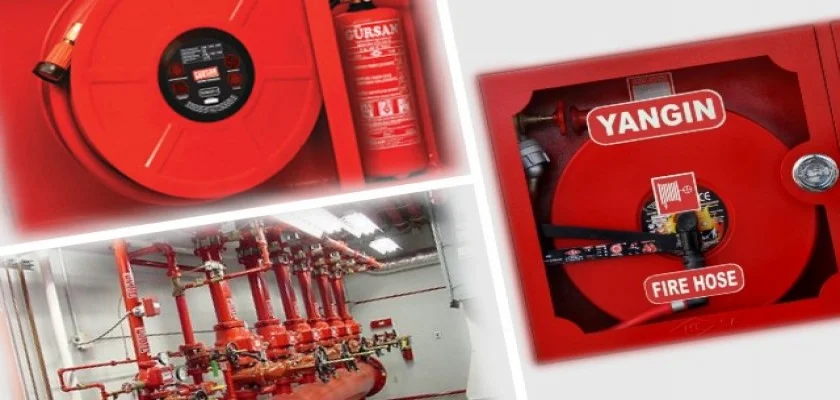
Contents of Fire Cabinets
The fire cabinet extinguishing system pipes, manually operated, should be made of 2-inch seam black pipe or galvanized iron. The connection method of the pipes to be used in the installation may vary depending on the type of pipe. Pipe connections are generally made using one of the threaded, welded, flanged, and clamped connection methods. Before connecting the installation pipes leading to the fire cabinet, care should be taken to ensure that the pipes are free of dirt, rust, and burrs. At the same time, care must be taken to ensure that the connection points of the installation pipes do not leak. For this purpose, liquid sealant, flax, or Teflon tape should be used. Fire cabinets are used in manually operated fire extinguishing systems. Although the fire cabinets used vary according to the size of the structure, they must have minimum dimensions of 600 x 700 x 160 millimeters. The internal contents of fire cabinets include a fire valve, a foldable canvas hose resistant to a pressure of 10 kgf / cm2, or a semi-rigid rubber hose containing rubber. At the end of the hose are sprinklers called a nozzle or jet. The hose inside the fire cabinet is stored wound on a reel, and this reel is designed so that the hose can intervene in the burning area without tangling during a fire. Other canvas hose fire cabinets have a shelf to store the hose. The length of the fire hoses should be between 10 and 30 meters.
Cabinet Types and Placement
Fire cabinets should be located as close as possible to fire exits or fire refuges in structures, be easily accessible, and visible. In the event of a fire, fire cabinets are used by people within the structure or by fire department personnel. There are many fire cabinet models on the market. These cabinets are divided into two types: valve-controlled and jet-controlled. Canvas hoses are used in valve-controlled cabinets, and intervention in the fire is made by opening the valve, filling the hose with water. In jet-controlled cabinets, the semi-rigid rubber hose is simpler and faster to use because it is already filled with water. The jet at the end of the semi-rigid hose made of rubber can be opened to directly intervene in the fire area. It is designed to be usable by anyone, especially in situations where no fire training has been received and the fire department has not yet arrived.
www.intekendustriyel.com